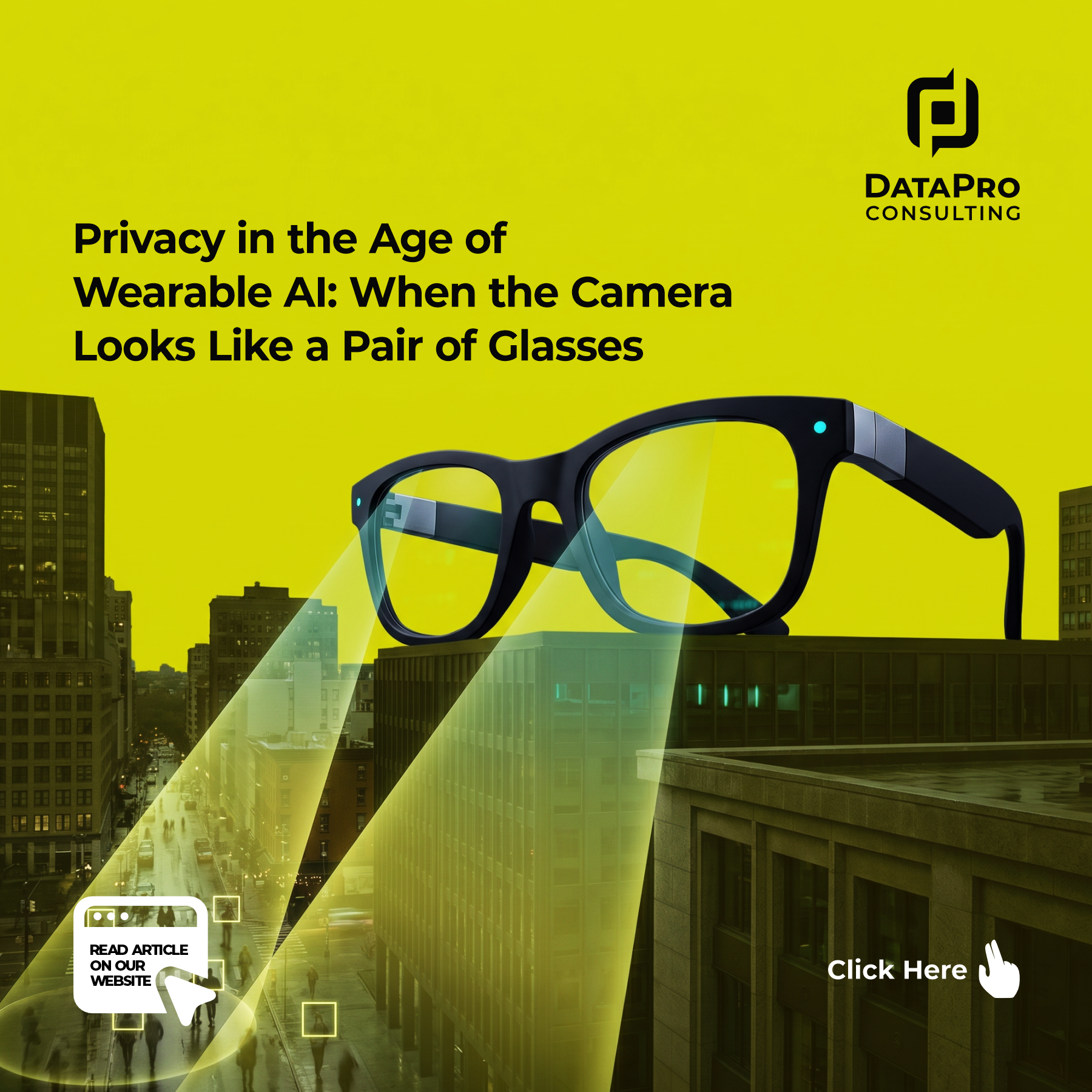
Imagine you are sitting across from someone at a coffee shop.
They are wearing an ordinary-looking pair of Ray-Bans. You are talking about work, your family, perhaps something you would rather not have repeated.
Are they simply looking at you?
Are they taking a photograph?
Are they recording?
Or is an artificial intelligence system looking at what they are looking at?
Increasingly, we may not know.
That is what makes AI-powered smart glasses different from the cameras we have spent the last two decades learning to live with. The camera has not suddenly appeared in public life. It has simply become much harder to notice.
And that seemingly small change may require us to rethink what privacy means when the technology is worn on someone’s face.
The Camera Has Disappeared Into the Background
Ray-Ban Meta glasses can take photographs and video, capture audio and interact with Meta AI. Meta says millions of people now use its AI glasses every day. About Facebook
There are obvious benefits.
You can photograph something without reaching for a phone, listen to music, make calls, ask AI about something you are looking at or capture a moment exactly as you experienced it.
For accessibility, travel, education, work and everyday convenience, wearable AI could become genuinely useful.
The privacy problem is not necessarily what the glasses can do.
It is how little the people around the wearer may understand about what they are doing and who has access.
When someone takes out a smartphone and points it towards you, decades of social conditioning tell you what may be happening. And there is something more unnerving about being recorded than the statement that our phones are listening to everything we do, but that may need to be explored in another article.
Glasses do not provide the same signal.
Meta made an adjustment after privacy concerns highlighted this as a problem. Its glasses include an outward-facing white “capture LED” that flashes when a photograph is taken and continues blinking during conventional video recording. On newer generations, Meta says attempts to cover or tamper with the LED can disable the camera. About Facebook
That is a sensible privacy-by-design measure.
But it does not come close to solving the problem.
According to Ray-Ban’s current product information, on newer models certain AI features can use the camera without illuminating the capture LED because the image is being used to fulfil an AI request rather than being captured for sharing. Ray-Ban says those images are not stored in Meta AI conversation history, identifiable information such as licence plates and phone numbers are removed, and facial recognition is not used. Ray-Ban
Technically, there is a distinction between taking a photograph of someone and allowing an AI system to see something temporarily so that it can answer a question.
To the person standing in front of the glasses, however, that distinction may be considerably less obvious.
And that is where the conversation becomes interesting.
Whose Privacy Settings Are They Anyway?
When you buy smart glasses, you can configure your privacy settings.
The stranger sitting opposite you cannot.
Meta allows wearers to manage preferences relating to captures, voice and notifications and says photos and videos remain on the glasses until the wearer chooses to import them to a phone. Voice recordings associated with Meta AI can also be deleted. Meta
Those are important controls.
But they largely give agency to the wearer.
The bystander has a different problem.
Your face may enter the frame. Your voice may be picked up by the microphone. Your child may appear in the background. A confidential document may be visible on your desk. A computer screen, licence plate, home address or private conversation may inadvertently become part of somebody else’s digital interaction.
You did not buy the device.
You did not accept its terms and conditions.
You may not even know exactly what it is doing.
Yet your information can still enter the ecosystem.
That reverses the usual privacy relationship.
“But You’re Already Surrounded by Cameras”
There is a reasonable counterargument.
CCTV is everywhere. Tourists carry cameras. Smartphones can record discreetly. Doorbells have cameras. Cars have cameras. People have been appearing in strangers’ photographs for as long as portable cameras have existed.
Why should glasses be different?
Because friction matters.
Taking out a phone, opening the camera and pointing it towards someone is a small act, but it creates visibility. The photographer knows they are doing it. The subject has a reasonable chance of noticing.
Wearable technology removes much of that friction and much of your choice.
AI adds another layer. The device is no longer necessarily capturing something because the wearer wants a photograph. It can increasingly interpret the environment around the wearer.
That trajectory matters more than any individual feature available today.
Meta is already opening its wearables platform further to developers, including access pathways involving camera, audio, speech, motion, location and AI services. Meta Developers
So the privacy question is not simply, “Can these glasses record me?”
It is:
What happens when computers continuously seeing the world from our point of view becomes normal?
Jamaica’s Data Protection Act Still Matters
For Jamaican organisations, wearable technology does not exist outside our existing data-protection framework.
Jamaica’s Data Protection Act requires personal data to be processed fairly and lawfully. The Office of the Information Commissioner highlights principles including fairness, lawful processing, transparency and appropriate conditions for processing personal information. Office of the Information Commissioner
But context matters.
Someone incidentally appearing in a tourist’s personal photograph is quite different from an organisation deliberately using smart glasses to record customers, employees, patients or visitors.
If businesses begin deploying wearable cameras for inspections, security, customer service, training, field work or AI-assisted operations, the governance question becomes much more serious.
Who is being captured?
For what purpose?
Where does that information go?
How long is it retained?
Can employees turn recording on whenever they wish?
Could confidential information be exposed?
What happens when customers object?
Those questions should be answered before the glasses enter the workplace.
That reflects a principle DataPro has argued elsewhere: privacy maturity is governance rather than simply having policies sitting in a folder. Data Privacy Week 2026 Day 5]_ …
Perhaps Consent Should Work the Other Way Around
There is an even bigger question for manufacturers.
Why should the person being observed carry most of the burden of opting out?
Researchers are already experimenting with a different model.
Research presented at CHI 2026 examined privacy-by-default camera glasses in which faces are blurred automatically and only restored after the individual provides consent. Participants who were bystanders strongly supported the opt-in approach, although wearers understandably wanted safeguards that could adapt to different situations. DOI
Separate 2026 research published through IEEE demonstrated a prototype capable of performing bystander anonymisation on the device rather than sending raw imagery elsewhere for processing. IEEE Xplore
That points towards a more ambitious standard for responsible wearable technology:
privacy should increasingly be engineered into what the glasses see, rather than relying entirely on everyone around the wearer to protect themselves.
Imagine glasses that automatically blur unfamiliar faces unless consent is provided.
Or businesses and schools broadcasting a privacy signal telling compatible wearable cameras not to record.
Or particularly sensitive locations triggering a privacy mode.
Or visual and audible indicators that communicate differently when AI is analysing the environment versus when video is being permanently captured.
None of those ideas requires us to reject wearable AI.
They require us to design it better.
So What Does Responsible Use Look Like?
Until stronger technical standards emerge, much of the responsibility sits with the person wearing the glasses.
A useful rule is remarkably simple:
If you would feel the need to ask before pointing your phone camera at someone, ask before recording them through your glasses.
Meta itself recommends asking permission before capturing people and avoiding sensitive locations or places where people reasonably expect privacy. Meta
Responsible wearers should go further.
Don’t record private conversations simply because the technology makes doing so easy. Be particularly careful around children. Remove the glasses or disable relevant functions during confidential meetings, medical appointments and sensitive workplace discussions. Tell people when you intend to capture them. Review what you have recorded before uploading it. Delete material you do not need. And learn the privacy settings of the device rather than accepting the defaults without thinking.
Most importantly, respect a simple “please don’t record me”.
Technology does not need to make every socially acceptable behaviour legally mandatory before we practise it.
And How Do I Opt Out If Someone Else Is Wearing Them?
This is perhaps the uncomfortable part.
There is currently no universal button that allows a bystander to tell every pair of smart glasses: do not capture me.
In ordinary social situations, your most immediate control is still human: ask whether the glasses are recording or using the camera, ask the wearer not to capture you and ask for material containing you to be deleted where appropriate.
In workplaces, schools, healthcare environments, events and private premises, organisations can do considerably more by establishing clear rules about where and when wearable cameras may be used.
Legal rights after information has been captured or published will depend on the circumstances and jurisdiction. Even the UK Government, which has recently considered questions about smart glasses, has distinguished between ordinary lawful recording in public and conduct involving harassment, stalking, voyeurism or other harmful uses. UK Parliament
So we should be careful not to create the impression that appearing in somebody’s smart-glasses footage automatically constitutes unlawful processing.
Privacy is more complicated than that.
But legality should not be the ceiling for responsible behaviour.
The New Etiquette of Being Seen
We have been here before.
Smartphones entered restaurants, classrooms, workplaces and bedrooms long before society developed conventions about when taking them out was rude, intrusive or inappropriate.
Social media arrived before most of us properly understood what permanent public sharing meant.
AI is following much the same pattern.
Technology arrives first.
Etiquette follows.
Governance arrives later.
Smart glasses give us an opportunity to change that sequence.
The answer is not to fear them. There is enormous potential in wearable AI, and increasingly capable glasses are probably going to become part of everyday life.
But adoption should come with an important principle:
The right to wear a camera should not become an assumption that everyone around you has agreed to be part of its field of view.
Our earlier work on protecting likeness in the age of AI raised the broader question of who controls our face, voice and identity as technology becomes increasingly capable of capturing and reproducing them. Smart glasses bring that debate out of the internet and place it directly in front of us.
Quite literally.
The future may well involve computers that see what we see.
The challenge is ensuring they also learn something humans have understood for much longer:
Just because you can look does not always mean you should record.