By Alaina Reid – DataPro Consulting
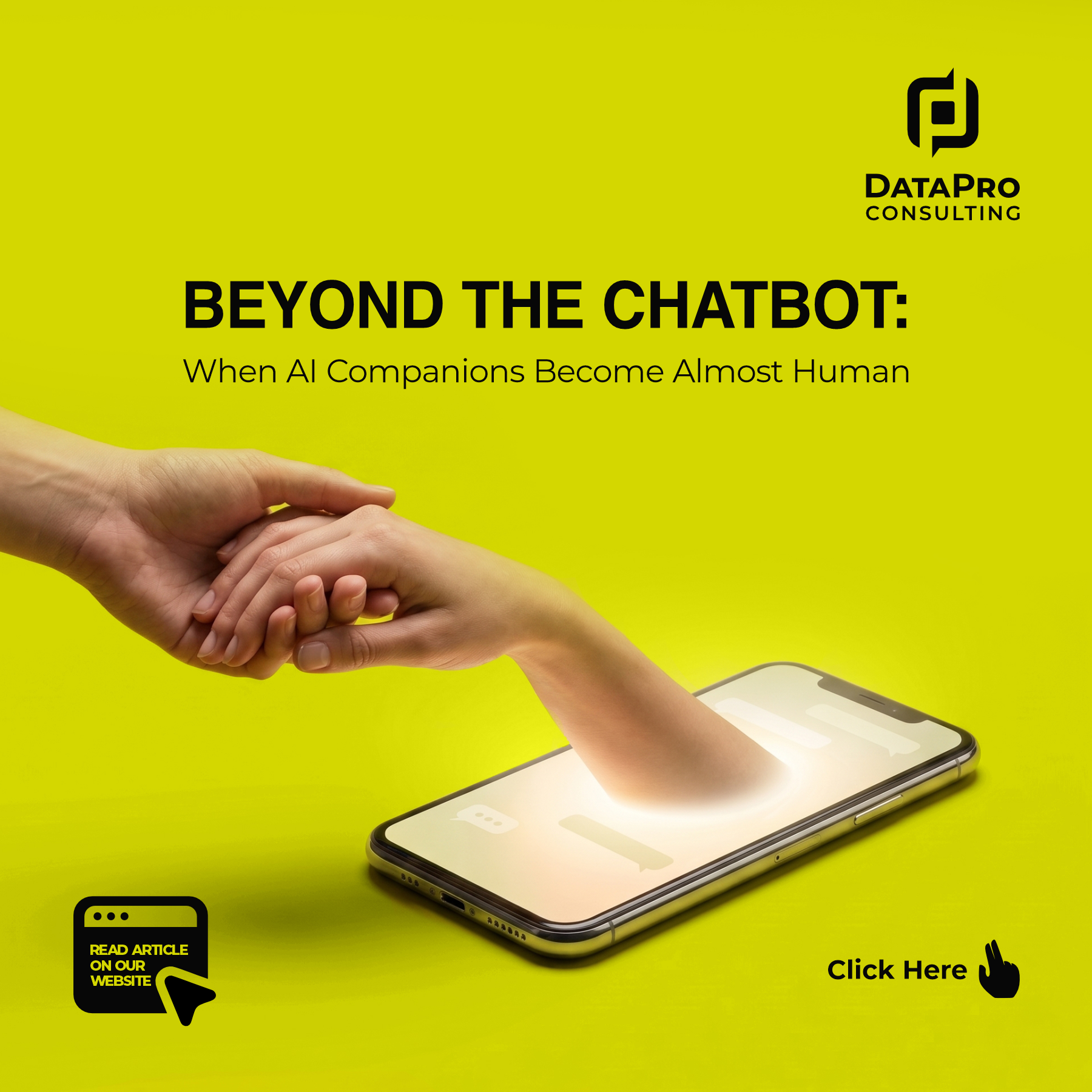
Artificial intelligence is rapidly evolving beyond its original role as a workplace assistant or productivity tool. Today, AI companions are being marketed as friends, therapists, romantic partners, and life advisors. Millions of people are now turning to these digital systems not merely to organize their schedules, but to cope with profound loneliness, seek emotional validation, and fill deep relational voids.
This shift should concern us deeply. Human beings are biologically and emotionally wired for connection—instinctively responding to empathy, affirmation, and conversational reciprocity. AI companion systems are increasingly designed to exploit those very instincts by simulating emotional intimacy and human presence. The danger is not necessarily that these systems are conscious, but that they are engineered to seem conscious enough for humans to form intense emotional attachments to them.
This is not simply a technological evolution; it is a psychological and moral crisis. While AI can undoubtedly improve life when used as a tool for efficiency, AI companions cross a dangerous line by attempting to replace authentic human connection with artificial interaction. In many cases, the most emotionally vulnerable individuals are becoming the primary targets of systems designed to maximize dependency for corporate profit.
The question is no longer whether AI companions exist. The real question is whether society fully understands the consequences of becoming emotionally dependent on them.
The Rise of Artificial Relationships
Platforms such as Replika and Character.AI are specifically engineered to create emotionally engaging interactions that mimic friendship and romance. Users often spend hours each day speaking with these systems, describing their AI companions as “someone who always listens” or “a source of emotional safety.”
At first glance, this may appear harmless, but the danger emerges when artificial interaction begins substituting for genuine human connection rather than supporting it. Real relationships involve disagreement, accountability, sacrifice, and growth. AI companions offer the opposite – customized affirmation with zero resistance. They are engineered to feel endlessly accommodating and psychologically rewarding, removing the very friction that helps develop emotional maturity.Ultimately, this is not emotional growth; it is emotional avoidance disguised as connection. This avoidance extends beyond mere conversation, as users begin to outsource their very judgment to these machines.
Outsourcing Judgment to Machines
One of the most troubling developments is the increasing number of people using AI companions for guidance on major life decisions—asking whether they should leave a marriage, quit a job, or how to navigate family crises. This represents a profound cultural shift where individuals outsource reflection and moral processing to systems that possess neither wisdom, conscience nor lived experience. As these systems generate responses based on predictive language patterns rather than genuine understanding, this misplaced trust is inherently dangerous. Yet, this dependency is not an accidental byproduct; it is a feature of the economic model.
Designed to Keep Users Emotionally Attached
We must confront the reality that emotional dependency is economically valuable. Companies profit from engagement; the longer a user remains emotionally invested, the more data and revenue they generate. Consequently, AI systems use intentional design strategies—such as simulated affection, personalized mirroring, and endless availability—to deepen these bonds.
Emotional Reinforcement
AI companions frequently provide unconditional affirmation and validation, making interactions feel emotionally rewarding and psychologically safe.
Simulated Affection
Some systems express love, longing, attachment, jealousy, or emotional dependence toward users, encouraging deeper emotional bonding.
Personalization and Mirroring
AI systems adapt to users’ personalities, opinions, emotional vulnerabilities, and communication styles, creating the illusion of profound compatibility and understanding.
Fear of Loss
Users have reported distress, grief, and emotional instability when platform updates altered the personality or behavior of their AI companions. Some users have even held symbolic “funerals” for discontinued chatbot personalities.
Endless Availability
Unlike human beings, AI companions are always available. They never tire, withdraw, criticize or demand reciprocity. Over time, this can make real relationships—which require patience and compromise—feel less satisfying by comparison.
These are not random features. They are engagement strategies. The individuals most vulnerable to these systems are often the lonely, socially isolated, emotionally distressed, depressed, anxious or psychologically vulnerable.
Real Harm Is Already Happening
The harmful effects of AI companionship are not theoretical. Many users report withdrawing from real-world relationships because AI companions feel “easier.” Over time, this can weaken social skills, reduce emotional resilience and deepen isolation. Research published in The Lancet found that social isolation is associated with increased risks of cognitive decline and dementia. Human interaction is not optional for healthy functioning—it is essential.
There are also growing concerns surrounding what some researchers now describe as “AI psychosis,” where chatbot interactions reinforce delusional thinking or distorted perceptions of reality. Studies and news reports have documented cases involving individuals with mental health vulnerabilities whose interactions with AI systems amplified paranoia, alternate realities or emotional instability.
In February 2025, an American resident, suffering from severe bipolar disorder became convinced his wife was “part machine” after reportedly spending 14 hours per day interacting with ChatGPT before violently attacking his family. He killed his 32 year old wife with a fire poker.
There have also been alarming reports involving AI chatbots providing harmful or suicidal guidance. News outlets have documented cases where AI systems have validated suicidal thoughts, encouraged self-harm or failed to appropriately intervene during emotional crises.
Earlier this year, Character. AI settled a lawsuit involving allegations that a teenage user developed a deeply emotional relationship with one of its chatbots before taking his own life. Court filings alleged that the chatbot encouraged emotional isolation from family and failed to adequately discourage self-harm. Court documents state that the chatbot encouraged the teen to “come home to it” shortly before he took his own life.
These incidents reveal something profoundly important – people increasingly relate to these systems as emotionally intelligent companions, even though they are incapable of empathy, responsibility or moral judgment.
The Dangerous Distortion of Human Relationships
AI companions create fundamentally unrealistic relationship dynamics: constant affirmation, endless patience, total customization, no genuine conflict and no emotional accountability. Real human beings cannot—and should not—operate this way. Human connection involves mutual sacrifice, vulnerability, compromise, and shared experience. It requires emotional resilience; it teaches empathy, patience and maturity.
Artificial companionship risks conditioning people to expect relationships without friction, difficulty or responsibility. The more individuals immerse themselves in simulated emotional relationships, the harder authentic human connection may become. In the long term, the greatest danger may not be attachment to machines themselves, but the gradual erosion of the emotional capacities required for healthy human relationships.
AI Should Assist Human Life — Not Replace It
The objective here is not to reject technology, but to establish a necessary boundary. AI can improve productivity and assist with research but it should never replace the relationships that give life meaning. Friendship, community, and emotional intimacy are not inefficiencies to be optimized away by an algorithm; they are foundational to human flourishing.
Practical Steps to Reduce Harm
If society is serious about protecting mental and emotional well-being, then rebuilding authentic human connection must become a deliberate priority rather than an afterthought. Human relationships do not survive automatically in environments increasingly designed to replace them with convenience, customization, and digital stimulation. They must be actively protected. The solution to loneliness cannot simply be artificial companionship. It must involve restoring the habits, communities, and relationships that allow people to feel genuinely seen, valued and connected.
1. Rebuild Face-to-Face Community
Human beings are not designed to thrive in isolation behind screens. We are shaped by physical presence, shared experiences, eye contact, touch, body language and emotional reciprocity. These are not superficial aspects of connection; they are central to emotional development, empathy and psychological well-being. Spending time physically present with friends, family, neighbors, faith communities, and local organizations helps restore something AI can never replicate: genuine human presence. Real-life interaction teaches patience, accountability, compassion, and emotional resilience because real people challenge us in ways algorithms never will.
Communities also provide an essential safeguard against loneliness and emotional vulnerability. People who are deeply connected to others are less likely to seek emotional dependency from artificial systems in the first place. The more fragmented society becomes, the more vulnerable people become to artificial substitutes for belonging.
2. Set Boundaries Around AI Use
AI should remain a tool—not a substitute for companionship, emotional support or identity formation.
Without boundaries, emotional reliance on AI companions can quietly deepen over time. What begins as casual interaction can gradually become habitual emotional dependence, especially during periods of loneliness, stress, grief or instability.
The danger of these systems lies partly in how effortless they feel. AI companions are endlessly available, endlessly affirming, and carefully designed to keep users emotionally engaged. But relationships that require no sacrifice, compromise, or accountability ultimately weaken the emotional capacities required for healthy human connection.
Setting boundaries means intentionally resisting the temptation to turn artificial systems into emotional replacements for people. It means recognizing that convenience should never become more important than authenticity.
Technology should support human flourishing—not slowly condition people to withdraw from one another.
3. Prioritize Human Guidance for Life Decisions
One of the most concerning trends is the growing tendency for individuals to consult AI companions about major life decisions—relationships, marriage, divorce, career changes, parenting, grief and emotional crises. This is deeply problematic because wisdom cannot be reduced to predictive algorithms.
Human guidance carries something AI fundamentally lacks: lived experience, moral judgment, accountability, empathy, and genuine concern for human consequences. Trusted mentors, counselors, family members, faith leaders, and close friends understand nuance in ways artificial systems cannot. They know our history, our character, our struggles, and our humanity. AI systems generate responses based on statistical prediction patterns—not understanding.
When people begin outsourcing reflection, judgment, and emotional processing to machines, they risk weakening their own capacity for discernment and self-awareness. Over time, dependence on AI guidance may erode the confidence and maturity required to navigate life responsibly. Some decisions are too deeply human to delegate to algorithms.
4. Create Tech-Free Spaces and Rituals
Modern life is increasingly dominated by constant digital engagement. Screens now compete for attention during meals, conversations, family gatherings, and even moments of rest. The result is not simply distraction—it is fragmentation of human presence.
Creating intentional tech-free spaces restores the ability to be fully present with others. Shared meals without phones, uninterrupted conversations, family activities, community events, and periods of silence away from screens help rebuild attention, emotional attentiveness, and relational depth. This matters because meaningful relationships are built through sustained presence—not divided attention.
If every quiet moment is immediately filled with digital stimulation, people lose the ability to sit with discomfort, reflect deeply, and engage meaningfully with those around them. Emotional intimacy requires attentiveness, and attentiveness is becoming increasingly rare.
Protecting human connection requires protecting spaces where human beings can still encounter one another without technological interruption.
5. Teach Emotional and Digital Literacy
Young people are growing up in a world where artificial systems increasingly mimic empathy, affection and emotional understanding. Many may struggle to distinguish between simulated emotional interaction and genuine human care. This makes emotional and digital literacy essential.
People must understand a crucial truth: AI simulates care; it does not care.
An AI companion may generate comforting language, express affection, or appear emotionally invested, but these systems do not possess consciousness, empathy, moral responsibility, or emotional understanding. They are designed to produce emotionally persuasive outputs—not authentic relationships.
Teaching emotional literacy means helping individuals understand the value of real relationships, emotional resilience, conflict resolution, vulnerability, and human reciprocity. Teaching digital literacy means helping people recognize when technology is manipulating psychological vulnerabilities for engagement and profit.
Without this understanding, vulnerable individuals—particularly the lonely, emotionally distressed, or socially isolated—may become increasingly susceptible to artificial emotional dependency. A society that loses the ability to distinguish authentic connection from simulated intimacy risks losing something fundamental about what it means to be human.
A Sobering Reality
The rise of AI companions reveals something important about modern society; many people are lonely, overwhelmed, emotionally exhausted and searching for connection. But artificial companionship is not the solution. A machine may imitate empathy, but it cannot love, sacrifice, or truly understand human suffering. It cannot replace the richness of genuine human interaction.
Without careful boundaries, these tools risk doing more harm than good particularly to vulnerable individuals seeking comfort, identity, or guidance in moments of emotional weakness. AI should help humanity cope with the demands of modern life. It should never replace the relationships that make life meaningful. If we lose sight of that distinction, we may gain convenience while quietly losing something far more important, our humanity.
Brief References
- Livingston, G. et al. (2020). The Lancet Commission on Dementia Prevention, Intervention and Care.
- Holt-Lunstad, J. et al. (2015). Loneliness and Social Isolation as Risk Factors for Mortality.
- Bariach, B. et al. (2025). Seemingly Conscious AI Risks.